Deflections for Specific Materials or Collections

Many of you are familiar with Deflection options available in the ILL Policies Directory. In the Policies section, you can create deflection policies based on format type, publication date, or maxcost as well as by your custom library groups. These policies are quite broad, and I am often asked if you can set a deflection policy based on your collection code for materials that don't circulate such as items in reference or special collections. There is a way to make this happen, but you will need to work with your colleagues in cataloging/metadata in order to enable deflection for specific items.
Here's some background:
ILLiad does not have a way to deflect requests according to your collection codes because OCLC requesting based on the WorldCat bib record (shared, high-level, bibliographic information), not your local catalog record which contains the indicators for collection, location, call number, circulation policy, etc. This is different from other resource sharing programs that may be based out of your circulation system (e.g. UBorrow, BorrowDirect, E-ZBorrow, etc.).
In order to deflect requests for specific items in your collection, a Local Holdings Record (LHR) needs to be added to the WorldCat to indicate, among other things, your ILL policy for that item. Incidentally, volume, issue, year information for serial records are also housed in the LHR.
LHRs are added and edited in the Connexion browser interface, and the creation of LHRs is governed by the Z39.71 Holdings Format and MARC 21 Format for Holdings Data (MFHD). Access to the Connexion browser is generally limited to cataloging/metadata users who are managing your WorldCat holdings.
When adding an LHR, deflection policies for lending and reproduction are set in the 008 bytes 20 and 21.
- Setting byte 20 to Will not lend and byte 21 to Will not reproduce will deflect ALL OCLC ILL requests for that item.
- Setting byte 20 to Will not lend and byte 21 to Will reproduce will deflect all loan requests but allow article requests for copying to come through to you.
(Note: these are only the values necessary for deflection. Other values will need to be added to the record in order to create an LHR that will pass the validation process.)
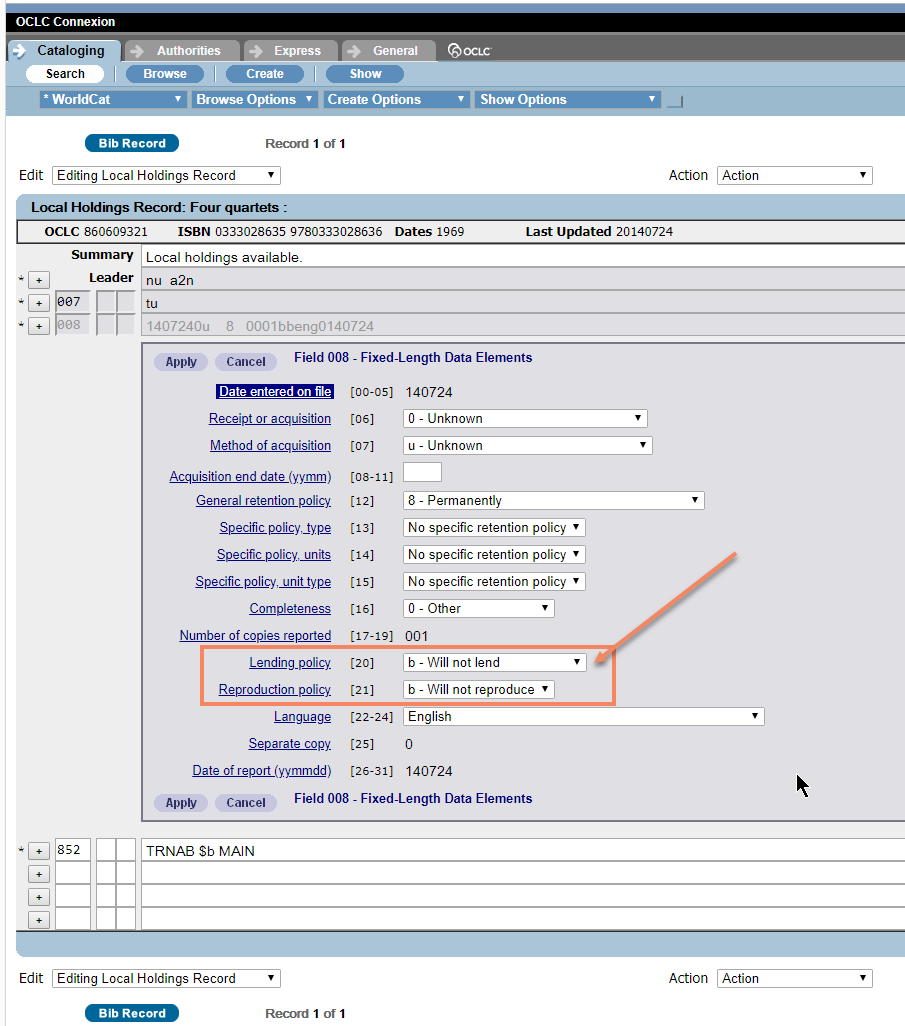
An LHR would need to be added for EACH item in a collection for which you would like to deflect requests. Consequently, while it is possible to deflect requests for all the items in your reference collection, it's probably a big ask of your colleagues in cataloging/metadata to create hundreds of records for all the materials that do not circulate.
Here are a few suggestions that I have given those who have asked me about it:
- Ask for cataloging access to WorldCat and get the training to add the Local Holding Records yourself. The process of creating these records can be a bit daunting for the uninitiated (I know it was for me!), but once you have a process down, you can create constant data records with the defaults, and add new LHRs with limited amount of effort.
- Ask cataloging/metadata staff to add LHRs on an ad hoc basis. Identify the materials for which you ROUTINELY get requests that you cannot fill (unique items in your special collections, popular items in your circulating collection, textbooks on reserve, etc.) and have them add LHRs as they are able for those items or notify them as you get requests for those materials.
- Contact OCLC about adding Local Holdings Records for a particular collection as part of a batch process. In the past, OCLC offered a batch process for adding LHRs as a part of the cataloging/metadata subscription. If you can export a set of OCLC numbers for materials in collection, they may be able to set up a batch process to add a template LHR for that set of records.
Comprehensive resources about LHRs are available here:
https://help.oclc.org/Metadata_Services/Local_Holdings_Maintenance
Because this service is provided as part of the OCLC Metadata Services Program, we cannot offer any support for Connexion browser or the LHRs creation process, but hopefully the information in this article can be a starting point for conversation with your colleagues to help with the influx of requests for materials that you are not able to lend.
Comments
Please sign in to leave a comment.